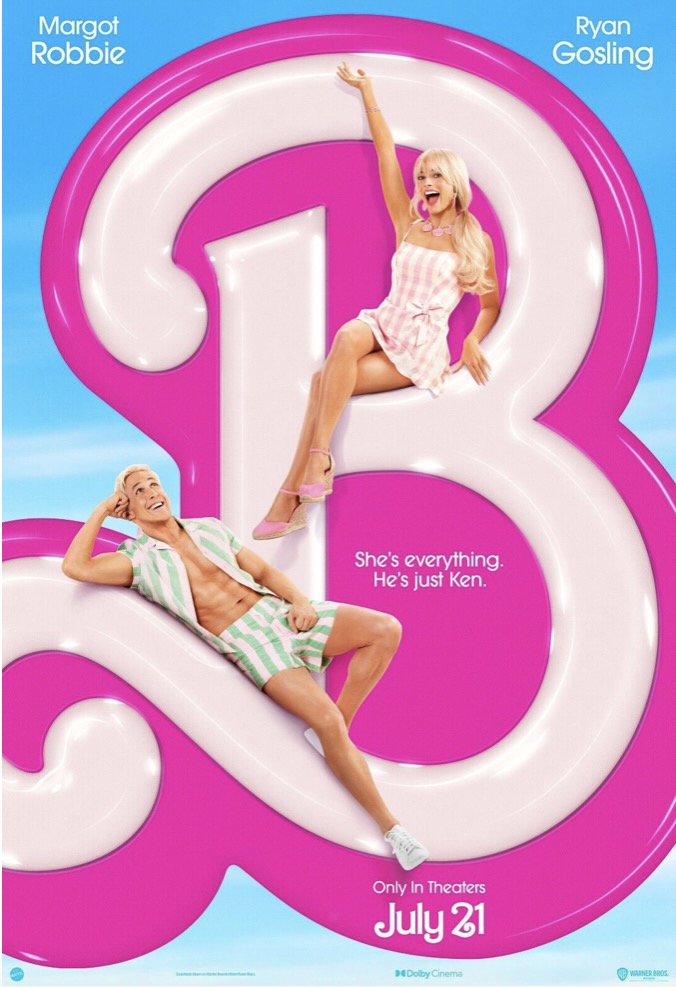
I saw the smash hit Barbie the Movie with my daughter Emma, 26, Wednesday. I found it highly entertaining (dance numbers!), frothy and feminine (pink everything!), and sharply disturbing (sexism, patriarchy!). Which, considering the way I played Barbies when I was a girl, totally makes sense.
From a very young age I adored Barbie. A trip to Kresge’s (the precursor to K-Mart) meant a magical stroll down the toy aisle, where dozens and dozens of beautiful outfits were displayed. When I was six or seven, buying a new Barbie outfit, complete with purse and shoes, could lead to many happy hours of solo play.
Fashion was my initial fascination with Barbie. Then, as I got older and starting playing Barbies with friends, the accessories became the focus—the swimming pool, the dream house, the Jeep and camper. But honestly, the pink plastic set pieces were never that engaging. How many times can Barbie take a dip? It was the stories we’d create that kept us enthralled.

Unlike my other dolls—Puddin’, the Madame Alexander babydoll and Sasha, the international schoolgirl—Barbie was an adult. My role wasn’t to take care of her or share age-appropriate experiences. She was a gorgeous grown-up who could go anywhere and do anything. My playmates and I used Barbie to explore situations we could only dream of—trips to France, beauty pageants, glamorous careers.
By the time were were eleven, we were old enough to be embarrassed about playing dolls, but not ready to give up our Barbies. We’d take them out stealthily, behind closed bedroom doors. It was the ’70s and our moms didn’t watch us anyway. Little did they know we were putting Barbie and company through some pretty racy scenarios.
Ken was a frequent kidnapper, sometimes teaming up with evil sorceress Barbie. “Good” Barbie and her innocent, plucky little sis, Skipper, had to endure all sorts of abuse as captives—being stripped of their finery, locked in a basement, starved and tortured—before they plotted ingenious escapes. Once free, they regained their full wardrobes and took their revenge on their captors. We called our game “Naked Barbies.” The stories (and the clothes) revolved around dynamics of power and, though we didn’t fully understand it yet, sex.
Did big-boob, tiny waist Barbie sexualize us? Or did we—pre-pubescent, crooked-teethed, awkward chubbies—sexualize her? I’d say the latter. The pretty, vacant dolls and their saccharine trappings became the backdrop for us to explore the taboo themes we could sense swirling around us.
Director Greta Gerwig and the writers of The Barbie Movie understand the multi-dimensional aspects of Barbie well. Barbie is both a simple toy doll and the complex projections of the desires and fears of the girls who play with her.
The movie opens to the pink wonderland you’d expect, and it’s fabulous. Every Barbie looks perfect and lives in a beautiful dream home. Every Barbie is fulfilled and happy, has supportive friends and a high status job. Every Barbie also has a Ken, if she wants one, which she mostly doesn’t, because every night is girls’ night and what could be more fun than that? The tagline of the movie is “She’s everything. He’s just Ken” which seems mean, but fitting. Barbies are girls toys after all. Girls should control this narrative.
The opening scenes of the movie are like my earliest Barbie experiences. It’s pretty, it’s perfect, the clothes are adorable, there’s a beach. But then life in Barbieland gets difficult for one Barbie, played by Margot Robbie. Whoever owns her in the real world is sad, and that misery is rubbing off on our Barbie, creating cellulite, flat feet and mayhem. So she and tag-a-long Ken (Ryan Gosling) head to the real world to straighten things out.
Alas, the real world is not kind to Barbie. It’s rough and ugly. Men ogle, disrespect and threaten her, and she is locked up for not understanding their ways. (Sounds familiar to my later storylines, no?) Ken, however, loves being a man the real world and decides to bring “patriarchy” to Barbieland. Okay, this isn’t a full review so I’m glossing over a lot of plot points and silliness here, but as you can imagine, Barbie journeys back to Barbieland with her new friends in tow, and through some ingenious girl power (i.e. feminism) they work with the other Barbies to defeat patriarchy and save the day. The storyline doesn’t completely hang together, but a big Ken dance-off number is ridiculously fun, so who cares?
I must note that Margot Robbie and Ryan Gosling are SO good in their roles here. It’s not easy to give a doll depth and humor, no matter how gorgeous and charming you are, and they both are masterful. I must also note that the six year-old sitting next to Emma was crying her eyes out halfway through the movie, begging her mother to take her home. This is not a movie for little kids, even though there’s no sex or nudity (unlike my naughty games). But if you’re an adult who ever played Barbies, I think you’ll get something out of this movie, even if it’s not what you expect.


This is great. Now I want to see Barbie. Thanks for your historical perspective.
LikeLiked by 1 person
It was over 50 years ago so that really was eons ago! 😂
LikeLike
I well remember shopping for Barbie clothes for you, with great pleasure. It occurs to me that mothers really enjoyed feeding into their little girls passion for these “toys.” Living vicariously?
LikeLiked by 1 person
It was so exciting! All those outfits to choose from. Thanks for the Barbie memories, Mom.
LikeLike